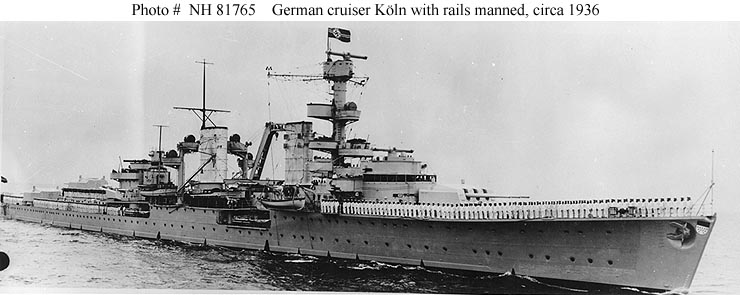
Some time ago, a well known local gentleman came into the Old Post Office Museum, Mornington and asked if we had any information on the German Cruiser Koln that had anchored off Mornington in the mid 1930s. This gentleman told the story that as a young boy, he and a friend rowed out to the ship and a warning flare or similar was shot across the water at them.
As part of the team down at the museum who handles any enquiries or research questions, I endeavored to find the answers to his questions, I personally had never heard of it and it would seem neither had many other people, there was nothing in our archives, so I told this gentleman that I was sorry I couldn’t help him, but I would get in touch with him if anything came up, feeling that this was unlikely to happen.
Well, life is stranger than fiction and within the month another well known local gentleman came into the museum and said to the person on duty if we would be interested in some information he had on the German Cruiser Koln, and donated to the Historic Society a Post Card with a coloured photo of the Koln on the front and signatures of the crew on the back. Also in this package was an extract from the book Music in the Country by Oliver Cameron telling a story of the ship’s visit.
I was thrilled to find this information waiting for me down at the museum, as was our first gentleman when I photocopied it all and sent it off to him.
We have a copy of Oliver Cameron’s book in our library, it had been donated to us some time ago by the Mornington CEF players, it is a great book telling the history of music in Mornington, it explained how a small contingent, from the Koln including the ship’s band came ashore. ‘On arrival at the pier, they formed into marching order, and marched down Main Street to the soldier’s monument at the intersection of Pt. Nepean Road, where they laid a wreath.’ The book further tells of how the committee of the Mornington Boy’s Military Band invited the German band to join the boys in a concert, the German band was very co-operative and agreed to do this. The Koln band was to take the stage for one half of the program, Mornington the other half.
It was to be held at the Plaza Theatre, and as a mark of respect, it was agreed the Mornington band would open the concert by playing the German national Anthem, while the German band would play the Australian National Anthem. The theatre was full, and the audience showed their appreciation of every item with enthusiastic applause, also the fifty members of the Boys’ Band were invited to visit the Koln. The Captain sent a launch to pick them up, they were shown over the ship and served tea in big thick mugs, all agreed it had been a great afternoon’s experience.
So in a short space of time, we had all this information available to us, not only about the Koln, but also a reminder of the wealth of information in Oliver Cameron’s book in our own library. But the story goes on, just recently we had an inquiry from Museum Victoria asking if we had any information on the German Cruiser, Koln. Isn’t this incredible? We were only too pleased to make copies of all we had at hand and send it off to them. Mr David Crotty of Museum Victoria is writing a book on the German ships that cruised our waters prior to WW2 and he was good enough to send us photostats of the newspaper articles about the Koln he had gathered from various archives, very exciting information. One article told how the Captain and crew of the Koln, which it was explained was a training ship, came ashore at Mornington to have afternoon tea with the Mayor and Councillors, and whilst there were presented with a German Iron Cross, a souvenir from the
First World War.
Captain Godfrey Grice who made the presentation expressed the wish that the Captain could return it to its original owner. The Captain was visibly moved by this wish and thanked the people of Mornington for its generosity. Maybe Mornington people and the Crew of the Koln should have been in charge of world affairs at that time.
*Originally published in South Eastern Heritage Issue 10,April 2009 and written by Val Wilson.